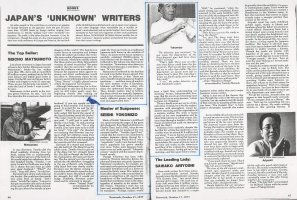
Master of Suspense - One of "UNKNOWN WRITERS" -
|
|
It was approximately 50 years ago, Seishi Yokomizo was once introduced as a "Master of Suspense" in an article titled "JAPAN'S ‘UNKNOWN WRITERS’" on October 17, 1977 issue of Newsweek magazine, but his works had never been channeled into any other languages before. This Newsweek’s article said about him as follows; Master of Suspense: SEISHI YOKOMIZO Much of Seishi Yokomizo's childhood was spent turning the pages of the great old whodunits, from Sherlock Holmes to Charlie Chan, and in 1921, when he was only 19 years old, he produced his own romantic thriller, "Terrible April Fool," a book that has come to be considered a modern Japanese classic. Except for a brief hiatus during World War II when "unpatriotic" works were banned, Yokomizo's popularity has grown steadily ever since. Today, most Japanese bookstores even set aside special "Yokomizo corners" stocked with the master's black-bound novels. Though Yokomizo has been influenced by Western detective fiction, his plots and characters are purely Japanese. Yokomizo's murderers, for example, are motivated not by greed or jealousy but by honorable intentions such as a desire to protect the family name. His victims are more often done in with a sword than by arsenic or a slug from a .38. And it is the breakdown of the traditional Japanese family that contributes most to the disintegration of morality in his stories. For this reason, Yokomizo's work has not been and, according to him, should not be translated. "Foreign readers would have a hard time understanding my meaning," he says. Yokomizo adds, however, that his novels are becoming more difficult for him to write because "values in Japan are changing." There is hardly ever any sex in a Yokomizo story. Instead, he rivets his readers' attention with atmosphere, sound deductive reasoning and the expectation of a surprise ending. His work is based purely on his own imagination and he takes little interest in actual crimes. (He once slept through a burglary of his own house and afterward made no attempt to catch the thief.) Yokomizo lives modestly despite the fact that his writing has made him a very wealthy man: he earned $1.2 million last year alone. "I am an honest and devoted taxpayer," he says, adding that Japanese readers expect their novelists to be non-materialistic. He wears a kimono most of the time and works on the tatami-covered floor of his writing den, beginning "in the afternoons, having got up in the morning - and then gone back to sleep." In 2019, more than 40 years have passed since the American magazine NewsWeek introduced Seishi Yokomizo as a “Master of Suspense” in an article titled JAPAN’S 'UNKNOWN WRITERS'. Inugami Curse and The Honjin Murders were published by Pushkin Vertigo, The Village of Eight Graves, Death on Gokumon Island and more continue to be published in English-speaking countries. Currently, the following works, which are representative works of Seishi Yokomizo, have been translated into English and published overseas. - The Inugami Curse (2019, formerly The Inugami Clan 2003) - The Honjin Murder (2019) - The Village of Eight Graves (2021) - Death on Gokumon Island (2022) - The Devil's Flute Murders (2023) - The Little Sparrow Murders (2024) - Murder at the Black Cat Cafe (incl. Why did the well wheel creak?, 2025) - She Walks at Night (2026) Although there have been translations into other European languages and Asian languages, we feel that the appreciation of Yokomizo’s works has just begun in the English-speaking world. We welcome the fact that Yokomizo’s works have finally been recognized and introduced to the world (English-speaking countries), in other words, that we have taken the first step toward exporting Yokomizo’s works overseas. We hope that the export of Yokomizo’s works as purely Japanese mysteries (multilingual translation and worldwide publication) will flourish even more in the future. Agatha Christie, said Seishi Yokomizo, “I would like to follow in the footsteps of my beloved Agatha Christie and write one novel a year until I am 80 years old,” and “I am not as good as Denchu Hirakushi, but at least I can be Christie”. Not only have Christie’s works been translated (into Japanese) and we can easily read many of them, but there are also many books introducing Christie’s works, such as Aoi Shimotsuki’s “Agatha Christie: A Complete Guide” (Hayakawa Bunko, April 2018). But what about the opposite? Despite being told that they would be ranked among the top in the world, none of Seishi Yokomizo’s works have ever been introduced to the rest of the world. Recently, English translations of major Seishi Yokomizo titles at last have been published, but this is only a small fraction of the number of Seishi Yokomizo’s works. It is not too late. We should not only import foreign detective novels, but also promote the export of purely Japanese mysteries as Yokomizo’s detective novels to overseas countries, especially to English-speaking countries. We hope that the English translations of Yokomizo’s works will continue uninterruptedly, and that the Yokomizo boom will continue to spread worldwide. The 21st century may well be the era in which we read Yokomizo’s works in English translations and in multilingual versions. |
|
Could you please inform if you know anything about SEISHI YOKOMIZO ? |
|Master of Suspense|サスペンスの巨匠|
 横溝ペディアへ |
 考古学事始めへ |
 ページの先頭へ |